When Love Feels Safe: The First Time My Nervous System Didn’t Panic
I didn’t realize love could make my nervous system feel quiet. Not numb. Not anxious. Not waiting for the catch. Just… calm. This weekend, I learned what it feels like when someone loves you in a way your body isn’t used to—and why even the good can feel overwhelming at first.
— The Most Beautiful Weekend
It didn’t start out as anything dramatic. My boyfriend, Ryan, had a busy weekend working at the racetrack for a big two-day event. I had Cub Scouts with the kids—plans to camp out, do the whole experience. But I ended up with a headache and went home to let it subside, it got late, and we never made it back to the campsite. Racing wrapped up early and my boyfriend texted me with an idea that felt so simple and so sweet: If we couldn’t camp there, we could camp in his backyard. So I packed up the kids and drove over. The kids camped outside in the tent under the sky, and he and I slept inside, wrapped up in his bed. It already felt like one of those core memories—easy, warm, a little chaotic, but deeply good. The next morning, we went to church together. Sitting next to him, worshipping with him there by my side, felt peaceful in a way that surprised me. It wasn’t performative. It wasn’t for show. It felt like something was aligning quietly inside me. After church, I had a swim lesson, so Ryan took the boys back to his house. The girls went with their dad. When I got there, he’d made lunch. We ate, had a bonfire going, played games, watched football, and when his daughter came home they played some more. It was just… life. Soft, ordinary, beautiful life. At one point, we got a brief window to sneak away and be alone. It felt like everything between us poured out in that moment: trust, safety, vulnerability, passion. It was honestly one of the most emotionally intimate experiences I’ve ever had. And that’s where things got interesting.
— The High: Love-Drunk on Safety
Right after, I remember feeling so full. Not just emotionally, but physically, mentally, spiritually. I felt “love drunk” in the best way—soft and warm and completely saturated with him. I even wrote that on a sticky note: “Love drunk.” It wasn’t the chaotic, all-consuming, anxious kind of high I’ve known in the past. It was grounded. Rooted. Safe. Everything in me was saying: This is right. This is good. This is love. But then, as the day wound down and it was time to leave, I felt myself start to crash.
— The Crash I Didn’t See Coming
We said goodbye, and even before I left his driveway, something in me dipped. My body felt heavy. My mood lowered. By the time I got to a gas station, I noticed something was off. Not emotionally—there wasn’t a triggering conversation, no rejection, no conflict. He hadn’t done anything wrong. If anything, everything had been right. I texted him to try to explain what I was feeling: > “So I think between last night and today I got an endless dose of dopamine from you… Just everything was so amazing and my dopamine receptors got so full and overwhelmed...I got up so high the come down came hard and fast… I think that’s why you said I looked sorrowful. I started to feel off at the gas station. I’m feeling better. The ‘balance’ is resetting.” It felt strange. This was the first time since my dopamine fast that I’d had that classic: high → crash → reset But this time, it wasn’t from chaos. It wasn’t from anxiety. It wasn’t from chasing someone who wouldn’t choose me. It was from love. From safety. From feeling that full. And that’s when I realized: This wasn’t an emotional problem. It was a neurochemical one.
— When an ADHD Brain Isn’t Used to Safe Love
As someone with ADHD, I live with a brain that runs naturally low on dopamine. That means when something feels good—really good—it lights up my system in a big way. Historically, my biggest dopamine spikes came from: uncertainty emotional whiplash chasing someone’s affection waiting on a text intensity without stability trauma-bond dynamics I’d confuse: anxiety with excitement chaos with passion inconsistency with chemistry And my nervous system started to believe that’s what “love” looks like. So this weekend, when I had: emotional stability predictability spiritual alignment physical intimacy safety joy kids playing in the background kindness consistency my brain still did what it always does with a big dopamine wave: it spiked… then crashed. But this time, the spike came from something new: healthy connection.
— When Intimacy Meets Neurochemistry
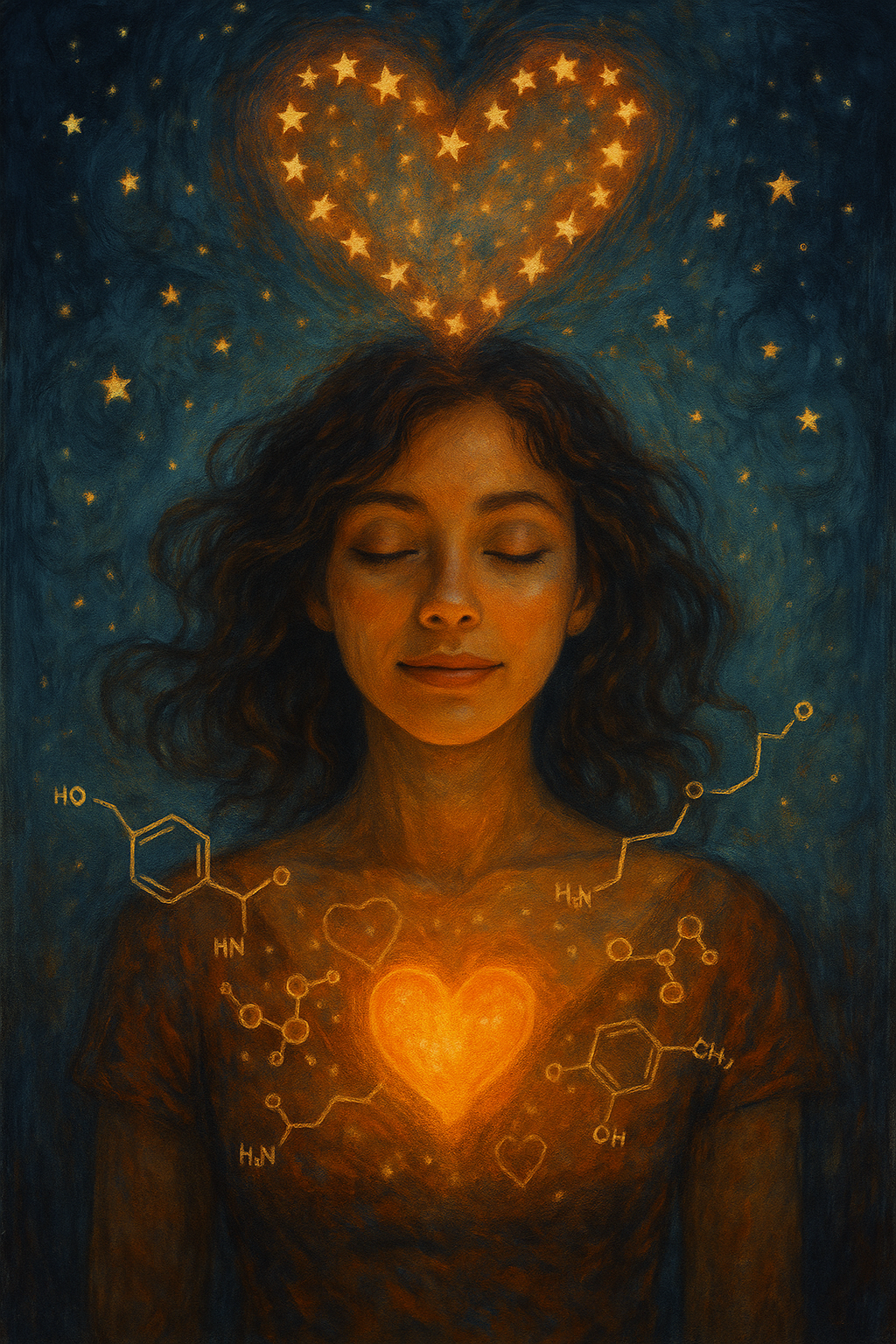
One thing I’m learning is that intimate moments aren’t just emotional—they’re deeply chemical. When we experience deep closeness and physical intimacy with someone we feel safe with, our brains release a powerful combination of neurotransmitters: Dopamine – pleasure & motivation This is the “reward” chemical. For an ADHD brain, dopamine hits harder and the swings are more dramatic. You feel the high intensely—and the comedown intensely, too.
Oxytocin – bonding & trust
Oxytocin is the “connection” hormone. It’s released during cuddling, eye contact, and especially during sex. It makes us feel attached, safe, and close. If you’re not used to safe affection, that level of bonding can feel overwhelming simply because it’s new.
Serotonin – calm & well-being
Serotonin brings that grounded, settled feeling—like, “I’m exactly where I’m supposed to be.” That’s the peace you feel after lying on someone’s chest, listening to their heartbeat.
Endorphins – relief & euphoria
These are the feel-good chemicals that ease stress and deepen the sense of pleasure and closeness. Together, this cocktail explains why: the intimacy felt so powerful the connection felt “love drunk” the crash afterward felt so sudden and yet, nothing was actually wrong For neurodivergent people—especially those with ADHD—this rush can be intense. A huge dose of “good” can still leave the brain temporarily dysregulated. The crash doesn’t mean the love is unstable. It means the brain is overloaded and resetting. And in my case, it wasn’t trauma or fear that overloaded it. It was joy.
— How I Knew This Was Healing, Not Harm
Here’s the biggest difference from the past: Trauma-bond crashes feel like: panic fear of loss obsession spiraling thoughts self-blame emotional whiplash This crash felt like: heaviness fatigue quiet fog emotional flatness my body hitting “power save mode” There was no story attached like: “He’s leaving.” “I messed it up.” “Something is wrong.” Instead, it felt like my body saying: “That was a lot. A lot of good. I need to reset.” And when I shared what was happening, my boyfriend didn’t freak out. He didn’t pull away. He didn’t shame me or make it about him. He just… stayed. Listened. Loved me through it. My nervous system learned something huge in that moment: > I can go that high in love and still be safe coming down. That’s not how my past looked. This is new. This is healing.
— What I’m Learning About Safe Love
This weekend taught me so much about myself, my brain, and love. I’m learning that: Healthy love can feel intense without being chaotic. Emotional safety doesn’t mean I never get overwhelmed—it means I don’t have to panic when I am. My nervous system isn’t broken; it’s unlearning old patterns. The crash isn’t a warning sign—it’s my brain recalibrating after a huge dose of joy. I’m not “too much” for feeling deeply; I’m just finally feeling it in a safe place. This was the first time my dopamine crashed because I felt full, not frightened. Full of love. Full of connection. Full of safety. And as strange as it felt, it might be one of the most important signs that I’m healing: My body is learning that love doesn’t have to be a war.
— Closing Thought: The Gentle Landing
For so long, I thought love was the high—the butterflies, the racing heart, the constant overthinking and wanting. But I’m starting to believe real love is actually the landing. It’s the moment after the high, when: there’s no panic no fear of being abandoned no need to chase no shame for feeling deeply Just a body slowly settling. A heart exhaling. A nervous system saying, “I’m safe now.” This weekend, I felt what it’s like for my brain to be overwhelmed by good, not bad. And as my system slowly evens out again, I’m holding onto this truth: > It’s okay for love to feel this good. It’s okay if my brain needs time to adjust. And it’s okay to let myself stay. Because this time, the crash wasn’t a sign to run. It was a sign that I finally let myself fully feel something real.
Author’s Note
If you’re someone with ADHD, trauma history, or a nervous system that learned to brace for impact instead of rest in love—this part is for you. Healthy love can feel strange at first. Not because it’s wrong, but because your body has never experienced safety without suspicion. When your brain is used to chaos, inconsistency, or emotional starvation, stability can feel overwhelming. Even joy can feel like “too much.” There is nothing wrong with you if: the good feels intense the calm feels unfamiliar your emotions spike and dip you need time to regulate love feels both safe and new You are not “too much.” Your nervous system is simply learning a different language—one built on safety, reciprocity, and presence. Healing doesn’t always look like stillness. Sometimes it looks like noticing the crash, naming it, and choosing to stay. Sometimes it looks like letting yourself be loved gently after years of surviving violently. If any part of my story felt familiar, I hope you remember this: Your body is allowed to relearn what love feels like. You are allowed to feel good. You are allowed to stay. And most of all—you are worthy of a love that doesn’t overwhelm your nervous system into panic, but slowly teaches it how to rest.